
Starbucks Calorie Calculator: Order Smarter Without Guessing

Quick answer: Do not stop at the headline calorie or macro number. Start with the serving you will actually eat, then check calories, protein, fiber, sodium, added sugar, saturated fat, ingredients, and allergens against your real goal.
Key takeaways
- Serving size usually changes the answer more than the label headline.
- Compare the tradeoff that matters most for your goal: calories, protein, fiber, sodium, added sugar, saturated fat, ingredients, or allergens.
- One item rarely decides the whole diet; repeated weekly patterns matter more.
- Use official labels and menus when available, then log the real portion you ate.
Definition: In this guide, a smarter food decision means checking the real portion, the practical tradeoffs, personal limits, and the repeat pattern before turning one answer into a rule.
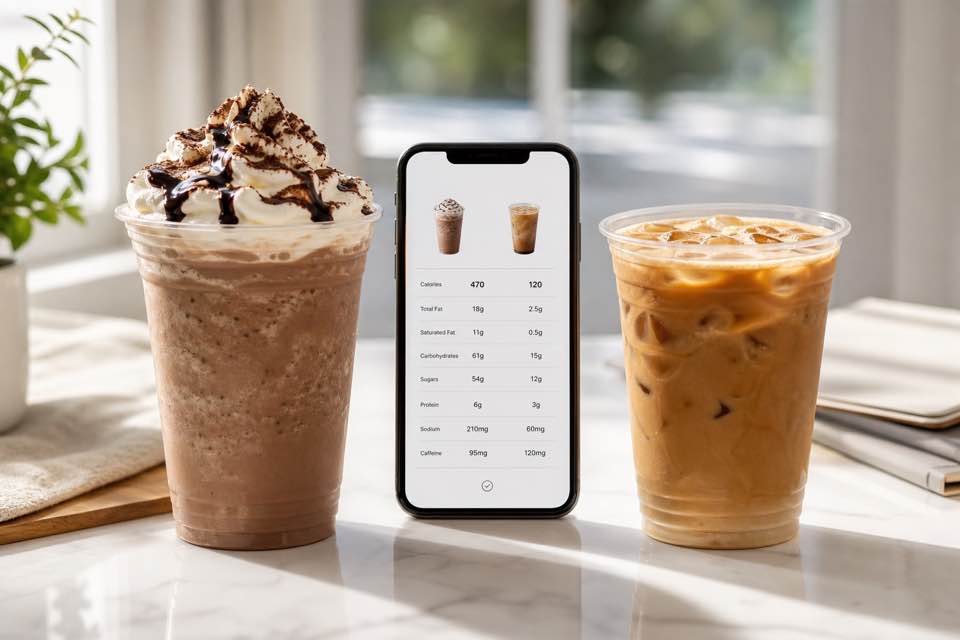
You order what sounds like a simple Starbucks drink, then realize the calorie number can swing hard depending on milk, syrup, cold foam, toppings, and size. A tall latte and a venti Frappuccino do not live in the same universe, but even two drinks with the same base can end up far apart once customizations stack up. That is exactly why search interest for a Starbucks calorie calculator keeps showing up: people are trying to get a clearer answer before a habit quietly turns into hundreds of extra calories a day.
Why Starbucks Calories Are Harder to Estimate Than They Look
At first glance, Starbucks seems easy to track. The menu is standardized, the drink names are familiar, and nutrition data exists somewhere online. In practice, though, most people do not order the default version.
The calorie total shifts because of a few common variables:
- Size jumps fast: going from tall to grande to venti changes both the base drink and the add-ons.
- Milk choice matters: whole milk, oat milk, almond milk, and nonfat milk do not land the same nutritionally.
- Syrup pumps add up: what feels like a small flavor tweak can become a major sugar increase.
- Cold foam and sauces are dense: mocha, white mocha, caramel drizzle, and sweet cream cold foam can change the drink much more than people expect.
- Food pairings hide the real total: a drink plus a bakery item or breakfast sandwich often matters more than the drink alone.
That means a generic menu board answer is useful, but it is often not enough for the drink you actually buy.
What a Starbucks Calorie Calculator Helps You See Quickly
A good calculator is useful because it turns a menu into comparisons instead of guesses. The real value is not just the final number. It is understanding which change moves the needle most.
For example, a Starbucks calorie calculator can help you compare:
- the same drink across sizes
- one milk choice against another
- standard syrup pumps versus a half-sweet version
- a default build versus a custom order with no whipped cream or no drizzle
That makes it easier to answer practical questions:
- Is the jump from grande to venti worth it?
- Does switching to a different milk meaningfully change the total?
- Is cold foam the thing pushing this drink from manageable to occasional?
- Which order gives the same coffee-shop experience with a better tradeoff?
The best use case is not perfection. It is faster decisions with fewer surprises.
The Biggest Calorie Traps in Popular Starbucks Orders
If you are trying to reduce guesswork, focus less on tiny differences and more on the highest-impact add-ons. These are usually the places where a drink stops behaving like coffee and starts behaving more like dessert.
Sweetened cold drinks
Iced drinks can feel lighter than hot drinks, but sweetness is still doing heavy work. Flavored cold brews, shaken espressos, and refreshers may look low-effort, yet the combination of syrup, juice base, or foam can raise the total fast.
Frappuccinos and blended drinks
These are the most obvious high-calorie candidates, but they still catch people off guard because the toppings are not the only issue. The blended base itself, plus sauce and whip, creates a stack of calories and sugar before you even start customizing.
White mocha, caramel, and sweet cream builds
These combinations are popular for a reason, but they are also where the hidden gap widens between “coffee drink” and “treat.” If your goal is weight management or more consistent logging, these are the first categories worth checking with a calculator.
Breakfast add-ons
A drink that fits your target can stop fitting the moment you add a loaf slice, pastry, or breakfast sandwich. For many people, the drink is not the real problem. The full order is.
How To Use a Starbucks Calorie Calculator Without Overthinking It
The fastest way is to use the calculator in layers:
- Start with the default drink and the size you actually buy.
- Change only one variable at a time.
- Identify the one or two changes with the biggest effect.
- Save your “usual” lower-friction order so you do not have to rebuild the logic every time.
This keeps the tool practical. You are not trying to engineer the mathematically perfect coffee. You are trying to find a repeatable order that fits your real life.
For many people, the most effective changes are boring but powerful:
- reducing syrup pumps
- skipping drizzle
- choosing a smaller size
- dropping whipped cream
- swapping a rich foam-heavy build for a simpler latte, americano, or cold brew setup
These changes are small enough to keep the order enjoyable, which matters. Extreme swaps tend not to stick.
Where Eatibo Fits Better Than a Static Calculator
A Starbucks calorie calculator is great for menu comparison. Eatibo helps when your order turns into a real-world tracking problem.
That matters because people do not just need a one-time number. They need a way to:
- log a custom drink quickly
- compare a drink with the rest of the meal or day
- notice patterns across repeat purchases
- keep calorie tracking tied to actual eating behavior, not isolated menu research
With Eatibo, you can use the calculator insight as the starting point, then scan and log the final choice into a broader nutrition picture. Instead of treating Starbucks as a random exception, you fold it into your everyday tracking workflow.
That is a better fit for real behavior. Most people do not struggle because they cannot find one nutrition fact. They struggle because the decision, the customization, and the logging are disconnected.
Smarter Starbucks Swaps That Usually Preserve the Experience
You do not need to order black coffee every time to make progress. A better approach is to protect the parts you care about most and trim the parts that matter least.
Here are common high-value swaps:
- Keep the flavor, reduce the pumps.
- Keep the drink, reduce the size.
- Keep the milk texture, skip whipped cream.
- Keep the iced coffee habit, skip drizzle and sweet foam together instead of one at a time.
- Keep the coffee run, switch the snack if the drink is already doing most of the calorie work.
This is where a calculator plus logging becomes useful. You stop relying on vague labels like “healthy” or “bad” and start seeing the real tradeoff.
A Simple Rule for Frequent Starbucks Orders
If Starbucks is an occasional treat, you probably do not need to optimize every detail. If it is part of your weekly routine, then even moderate differences matter.
A practical rule is:
- If you buy it often, standardize it.
- If you customize it heavily, calculate it.
- If you are trying to lose weight or maintain a target, log it.
That approach keeps the effort proportional to the impact. It also prevents the classic problem where coffee calories feel too small to matter until they repeat often enough to matter a lot.
The Bottom Line
The reason people search for a Starbucks calorie calculator is not just curiosity. They want a fast way to understand what their order is actually costing them nutritionally, especially when customizations blur the answer.
Use the calculator to compare drink builds. Use Eatibo to turn the final choice into a repeatable tracking habit. That combination is far more useful than guessing from memory or assuming a drink is “not that bad.”
Decision framework
| What to check | Why it changes the answer | Practical next step |
|---|---|---|
| Serving size or portion | Calories, sodium, sugar, carbs, and fat scale with the amount actually eaten | Log the realistic portion, not the ideal one |
| Protein, fiber, sodium, added sugar, and saturated fat | These decide whether the choice supports fullness and long-term habits | Compare the tradeoff that matters most for your goal |
| Ingredients, sauces, breading, or add-ons | Small extras can change the result quickly | Compare the base item and extras separately |
| Personal restriction applies | General nutrition advice cannot know every boundary | Follow allergy, medication, religious, or clinician-directed rules first |
Concrete examples
- If the food looks healthy but the serving is tiny, check what a realistic portion does to calories, sodium, or sugar.
- If two options have similar calories, choose the one with more protein, fiber, or ingredients you tolerate.
- If the food is occasional and you enjoy it, log it honestly instead of building a strict rule you will not keep.
Limits and safety notes
This guide is for everyday food awareness. It is not a diagnosis tool, allergy authority, medication checker, eating-disorder recovery plan, or substitute for a clinician or registered dietitian. For diagnosed conditions, pregnancy, kidney disease, diabetes medication, severe allergies, or clinician-directed diets, get professional guidance before changing your routine.
Where Eatibo fits
Eatibo is useful when a question turns into something you need to compare or log. You can scan a meal photo, barcode, nutrition label, or ingredient list, review calories and macros, check sodium, added sugar, allergens, additives, and ingredients, then save the result to your Nutrition Log. The point is not one perfect judgment; it is making the next similar choice easier because your own pattern is visible.
Sources and references
- FDA: Calories on the Nutrition Facts Label
- FDA: How to understand and use the Nutrition Facts label
- HHS/ODPHP: Current Dietary Guidelines for Americans
Frequently asked questions
Is this something I need to avoid completely?
Usually no. The better question is portion, frequency, and fit. A food can be fine occasionally but less useful as an everyday default if it repeatedly pushes sodium, added sugar, saturated fat, calories, or allergens past your limits.
What should I check first?
Start with the serving size you will actually eat. Then check the tradeoff most relevant to your goal: calories, protein, fiber, sodium, added sugar, saturated fat, ingredients, or allergens. The order matters because a tiny serving can hide a bigger real-world intake.
How can Eatibo help me decide faster?
Eatibo helps you scan or log the choice, compare the practical nutrition details, and review the pattern later. It is most useful for repeat decisions because the app can show whether similar foods are helping your weekly routine or quietly pushing it off track.
Related reading
- Decoding Your Subway Meal: More Than Just 'Fresh'
- AI Nutrition Coach: Decoding Your Food Beyond the Label
- Low-Calorie Wine Guide: What to Order When You Want the Glass Without the Guesswork
Last updated: June 1, 2026