
Calories vs Kcal: How to Read Food Energy Labels
On food labels, a Calorie and a kilocalorie (kcal) describe the same amount of energy, so changing the word from "Calories" to "kcal" does not require changing the number. The FDA's October 2021 glossary says that references to calories in its Nutrition Facts materials mean kilocalories unless stated otherwise. USDA Nutrition.gov also states that one kilocalorie is the same as one food Calorie. This answer applies to food-energy labeling. In other scientific settings, capitalization and context can change what "calorie" means.
The practical difference between kcal and calories on a food label is usually wording, not quantity. Before you copy either figure into a food record, confirm that both sources describe the same amount of food.
What calories and kcal mean on food labels
The FDA defines a Calorie as a unit used to measure the energy in food and beverages. Its glossary uses "calories" for kilocalories within the Nutrition Facts context. Nutrition.gov makes the one-to-one relationship explicit: 1 kcal equals 1 Calorie with an uppercase C.
That gives you a simple rule for food records:
| Word on the source | Meaning in this food example | What to preserve in the record |
|---|---|---|
| Calories | Food-energy kilocalories | Keep the printed number and the amount basis |
| kcal | Kilocalories | Keep the printed number and the amount basis |
| cal in an unclear source | Context may differ outside food labeling | Do not infer the unit from capitalization alone |
The phrase "kcal vs cal in food" needs that last context check. On a food label, kcal is clear; a bare "cal" elsewhere may need the source's own definition before you record it.
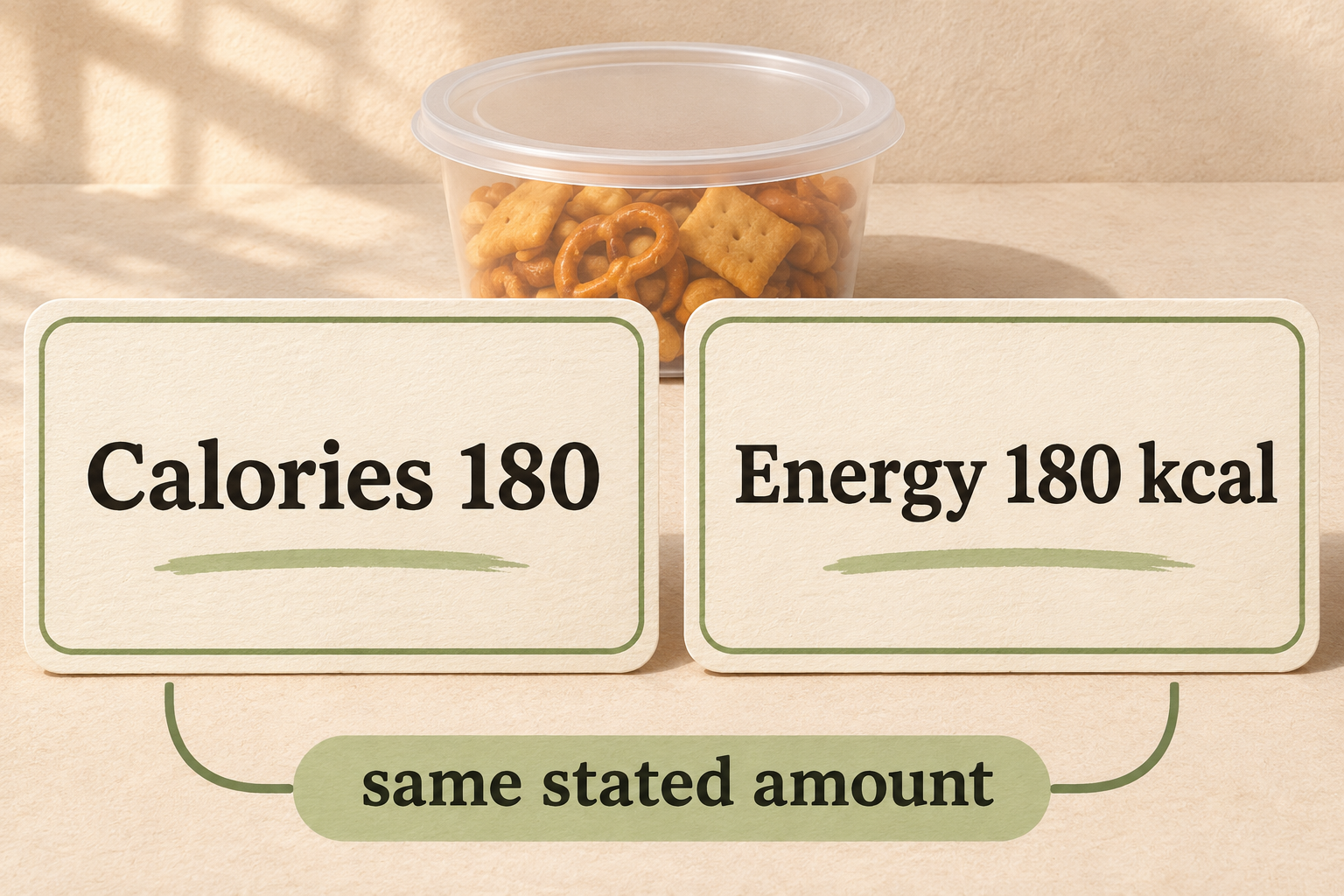
If one food source says "180 Calories" and another says "180 kcal" for the same stated amount, record 180, not 180,000 and not 0.18. The unit wording does not create a conversion step in this food-label example.
Read two energy snippets for the same amount
Imagine an unbranded snack with two fictional energy snippets. Both refer to one labeled portion of the same imaginary food:
| Fictional source | Energy line | Stated amount |
|---|---|---|
| Snippet A | Calories 180 | One labeled portion |
| Snippet B | Energy 180 kcal | One labeled portion |
These are teaching examples, not real packages, FDA samples, measured foods, or Eatibo scan results. Because the food-energy unit and the stated amount match, the number stays 180. That conclusion follows from the one-to-one food-unit relationship described by Nutrition.gov.
Fictional teaching illustration: the wording changes, while the energy number and stated amount stay the same.
Check the amount basis before comparing numbers
Matching energy units does not prove that two numbers describe the same quantity of food. A value per 100 g and a value per serving may both use kcal, but the amount bases differ. Likewise, two "Calories" figures can disagree because one covers a serving and the other covers a whole package.
The FDA's Calories page says the Calories figure gives the energy from all sources in a serving. It also explains that serving sizes reflect amounts people typically eat or drink and are not recommendations for how much to eat.
Read these fields together before comparing or recording a value:
- the energy number
- the written unit, such as Calories or kcal
- the serving size, weight, volume, or per-100-g basis
- the number of servings in the container, if the package lists it
- whether the figure covers one serving or the whole package
If you need to scale a value to what you ate, use the separate guide to serving and container calculations. Keeping that arithmetic in one place avoids mixing a unit question with a portion question.
Before you save a scanned food record
A scan can reduce typing, but the package remains the reference for the value you save. Use this short worksheet when the source says Calories, kcal, or an unclear variation:
| Check | What to record |
|---|---|
| Source | The exact package, label, or food-energy source |
| Energy | The printed number and written unit |
| Stated amount | The serving, weight, volume, package, or per-100-g basis |
| Package check | Whether the saved figure matches the package |
| Uncertainty | What remains unclear and which reliable source you will check |
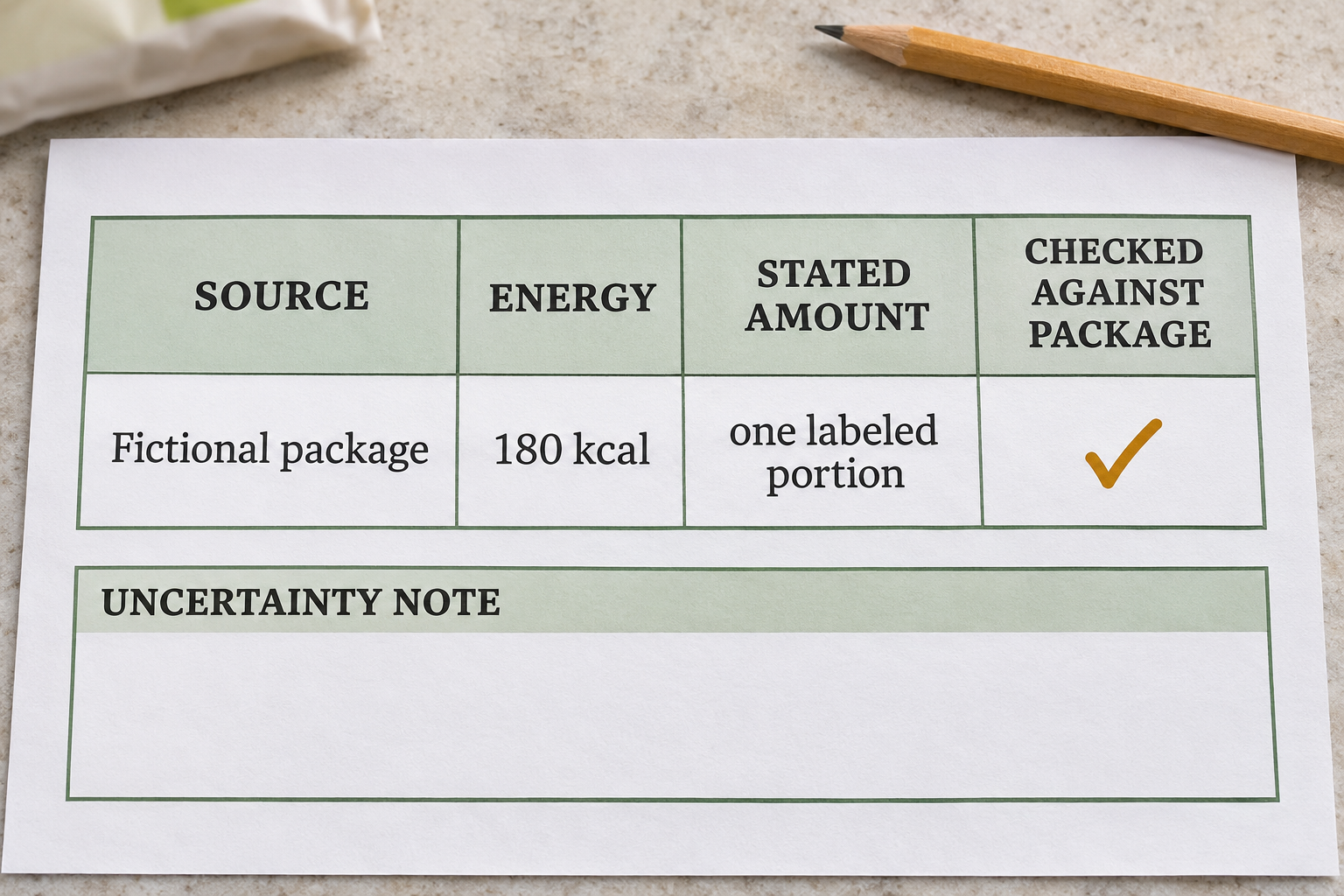
Generic editorial worksheet, not Eatibo product UI. The entry is fictional and shows the source, energy, amount basis, and verification status together.
Keep an unclear value unresolved instead of forcing a conversion. For example, when "cal" appears without a clear food-label context, look for the source's own unit definition. Capitalization can help, but it is not enough to interpret every scientific or technical source.
Eatibo supports food scanning and nutrition records. Check the scanned result against the package before saving it. Do not assume that a scanner will correct unit wording, serving bases, or recognition errors for you.
Short questions
Are calories and kcal the same on food labels?
Yes, in this food-label context. The FDA glossary uses calories to mean kilocalories unless specified otherwise, and Nutrition.gov states that 1 kcal equals 1 food Calorie. Keep the printed energy number when only the wording changes.
Does a different unit word explain two different numbers?
Not by itself. If two figures differ, check whether they cover the same food, serving, weight, or package amount. A change from Calories to kcal does not explain a numerical difference when the stated amount is the same.
Does Calories tell me the complete nutrition profile?
No. The FDA describes Calories as the energy supplied by the labeled amount. For a broader scan-and-check process, use the nutrition label scanner guide and read the other label fields that matter for your record.
One useful next step
Pick up one real package and find its energy number, written unit, and amount basis. Check those three items against the record you plan to save. If the package and record do not match, leave the value unresolved until you can identify whether the difference comes from the food amount, the source, or the entry itself.
Sources
- FDA, Interactive Nutrition Facts Label Glossary, October 2021, printed page 2
- USDA Nutrition.gov, Expert Questions and Answers: calories and kilocalories
- FDA, Calories on the Nutrition Facts Label
About the author
Eatibo Editorial Team
Eatibo content team
https://www.eatibo.com
The Eatibo editorial team explains nutrition labels, food scanning, and meal logging with practical examples and links to primary sources.