
Soluble Fiber vs Insoluble Fiber in Foods and on Labels
By Eatibo Editorial Team
Soluble fiber dissolves in water and forms a gel during digestion. Insoluble fiber stays undissolved. Their digestive roles differ, and both contribute to a varied diet. On a food package, start with the total Dietary Fiber amount, then look for any separately listed subtype grams. FDA dietary fiber guide
The difference between soluble and insoluble fiber
| What you are comparing | Soluble fiber | Insoluble fiber |
|---|---|---|
| Behavior in water | Dissolves and forms a gel | Remains undissolved |
| Broad digestive role | Slows digestion | Adds stool bulk and helps food move through the digestive tract |
| Examples of food sources | Oat bran, beans and lentils | Wheat bran, vegetables and whole grains |
The water behavior and digestive roles come from the FDA and MedlinePlus. Food examples describe sources associated with each type. FDA dietary fiber guide, MedlinePlus fiber comparison
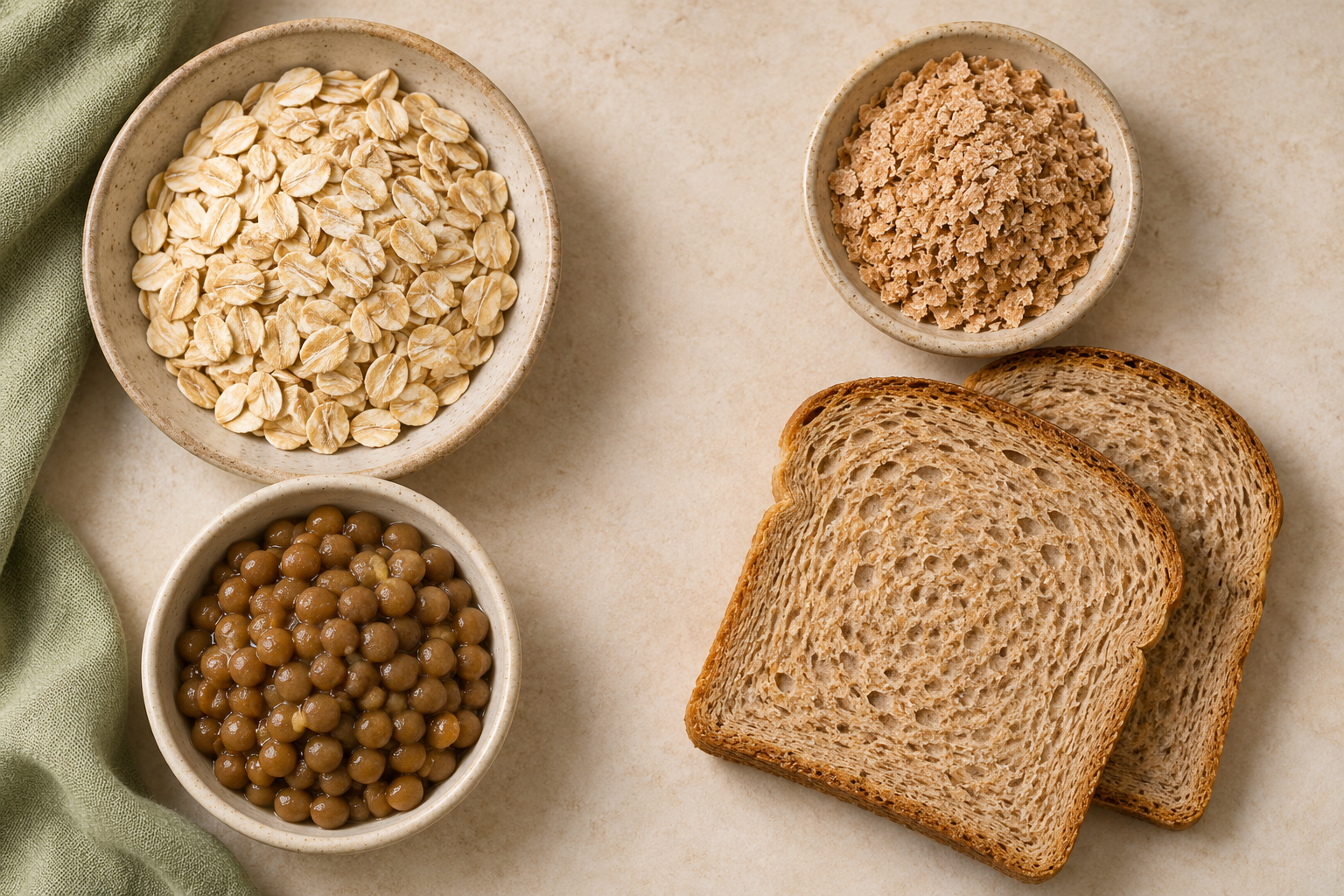
Food-source examples. The left side shows oats and lentils, associated with soluble fiber. The right shows wheat bran and whole-grain bread, associated with insoluble fiber. Foods can supply a mixture of fiber types.
Everyday food examples
MedlinePlus lists oat bran, beans, lentils and peas among soluble-fiber sources. Its insoluble-fiber examples include wheat bran, vegetables and whole grains. These examples help you recognize ingredients when planning a meal. MedlinePlus fiber comparison
Rolled oats also supply soluble fiber. The FDA identifies them as a source of beta-glucan soluble fiber in its food-claim regulation. The regulation describes both their soluble and total fiber, illustrating how one food can contain multiple fiber types. [FDA regulation on oat fiber](https://www.ecfr.gov/current/title-21/chapter-I/subchapter-B/part-101/subpart-E/section-101.81#p-101.81(c)(2)(ii)(A)(2))
For a breakfast comparison, consider oatmeal alongside a whole-wheat toast option. Oats illustrate a soluble-fiber source, while whole grains appear among the insoluble-fiber examples. The actual fiber grams depend on the food and amount served. Use the package figures for your chosen cereal or bread. An ingredient name alone leaves the precise subtype quantities unresolved.
For snack choices, the existing Eatibo guide walks through protein, fiber and other label details together. High-protein, high-fiber snack guide
Read total fiber and optional subtype rows
Find Dietary Fiber under Total Carbohydrate on a U.S. Nutrition Facts panel. Its grams describe the labeled serving. The adjacent % Daily Value (%DV) puts that amount in the context of a daily diet. FDA label-reading guide
Manufacturers may list soluble and insoluble fiber grams beneath the total. A claim about a subtype on the label or in labeling makes declaration of that subtype required. FDA dietary fiber guide, [21 CFR 101.9(c)(6)(i)](https://www.ecfr.gov/current/title-21/chapter-I/subchapter-B/part-101/subpart-A/section-101.9#p-101.9(c)(6)(i))
Fictional label examples. Every value below is invented for teaching. Each panel describes one labeled serving of an imaginary food. The illustration shows selected fiber rows.
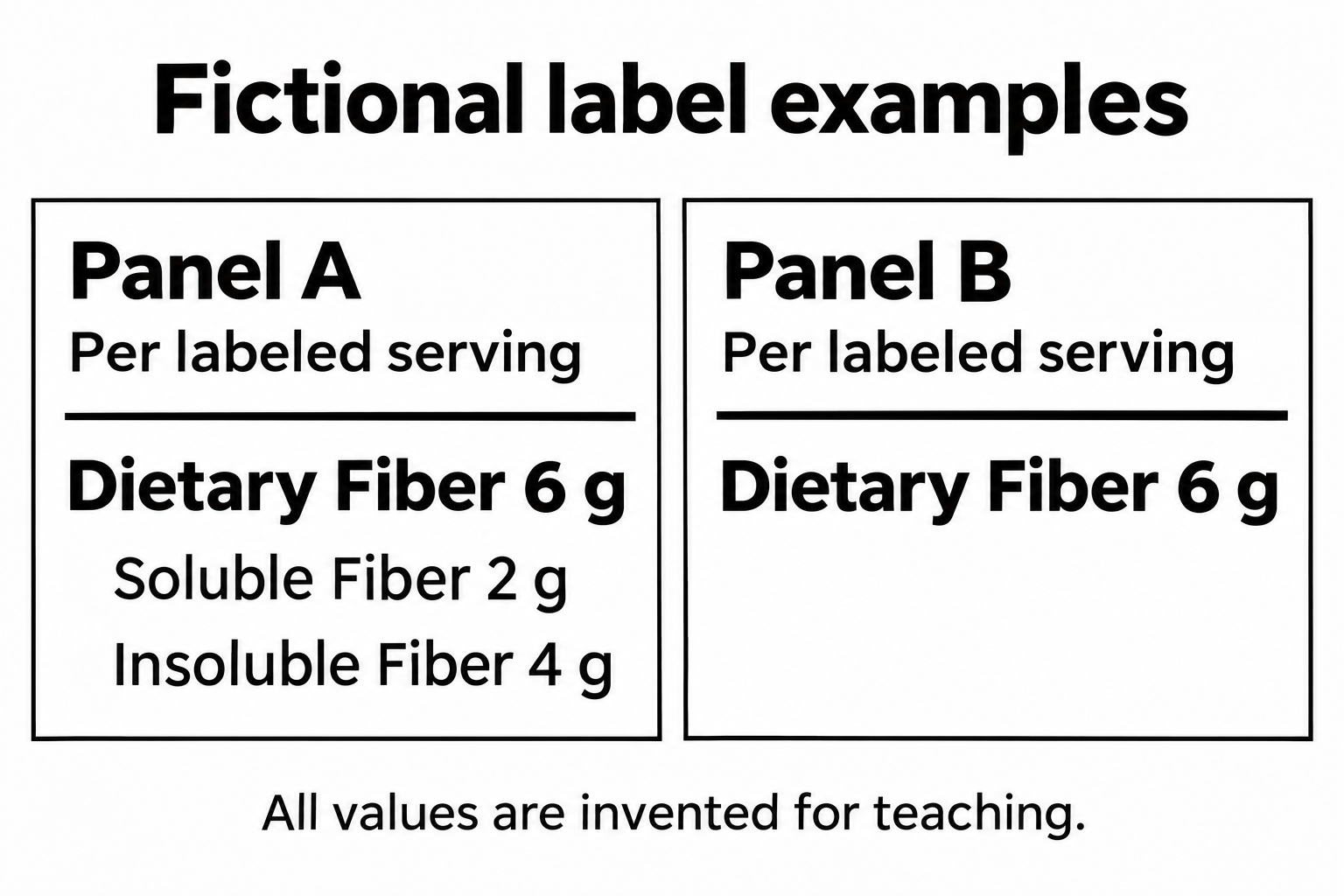
Fictional label examples with the same total fiber and different levels of detail.
| Information supplied per labeled serving | Panel A | Panel B |
|---|---|---|
| Total Dietary Fiber | 6 g | 6 g |
| Soluble Fiber | 2 g | Unknown |
| Insoluble Fiber | 4 g | Unknown |
In Panel A, 2 g plus 4 g equals the stated 6 g total. Record total fiber as 6 g, with the two subtype values describing its parts.
Panel B supplies the same total. Its soluble and insoluble amounts remain unknown. Keep that uncertainty when making a record. A matching total gives you a shared quantity to compare, while a subtype comparison needs further product-specific information.
For the broader scan-to-log process, follow Eatibo's label-reading walkthrough. Nutrition label scanner guide
Compare and record what the package states
- Check the serving basis. Read the serving size and column heading before comparing fiber grams. The nutrient values refer to the quantity named on the label. FDA label-reading guide
- Read total Dietary Fiber. Keep the gram amount together with its serving basis. This makes the entry understandable when you return to it later.
- Look for subtype rows. Carry over explicitly stated soluble or insoluble amounts. Leave missing subtype quantities unknown.
- Review ingredient context. Oats, lentils or wheat bran can help you recognize a fiber source. Use product-specific evidence for exact subtype grams.
When the amount eaten differs from the labeled serving, use the existing portion-scaling guide. It covers the arithmetic for serving and container values. Per-serving and per-container guide
Short reader questions
Must every label show separate soluble and insoluble grams?
Separate subtype amounts may be voluntary. Label claims about a subtype trigger its declaration requirement. 21 CFR 101.9(c)(6)(i)
How do I use a total-only label?
Record the stated total and serving basis. In fictional Panel B, that is 6 g per labeled serving. Keep the subtype quantities unknown until you have a reliable source for them.
Is one type universally preferable?
Both types have useful digestive roles. For everyday food choices, include varied fiber sources across meals. The FDA highlights vegetables, fruits, beans and grains as sources to include. FDA dietary fiber guide
Keep the label information with your food record
Eatibo supports photo, barcode and ingredient-label scanning, connected with nutrition records. Check the package, review the figures, and keep verified nutrition information with your food record in Eatibo. Eatibo