
Per Serving vs. Per Container: How to Read a Nutrition Label
By Eatibo Editorial Team
On a U.S. Nutrition Facts label, per serving gives the calories and nutrients for one labeled serving. Per container gives them for the whole package. First check how much you ate, then choose the values that match that amount. A package can contain several servings. FDA serving-size guidance
Find serving size and servings per container
Look at the top of the Nutrition Facts panel. Serving size gives a household quantity, such as pieces or cups, followed by a metric quantity. Servings per container tells you how many labeled servings the package holds. The FDA bases serving sizes on typical consumption. Recommendations about how much you should eat or drink are a separate question. FDA serving-size guidance
If you are asking “what does per serving mean?”, read the serving-size line alongside the calorie or nutrient value. Both describe the same quantity of food. FDA label-reading guide
For the calculations below, imagine a fictional package of snack crackers. All package amounts and nutrition values in this example are invented for teaching.
- The package contains 90 g.
- One serving is 30 g, so the package holds 3 servings.
- Each serving has 150 calories and 180 mg sodium.
Read the headings on a dual-column Nutrition Facts label
A dual-column panel can show values per serving beside values per package or per unit. Read the heading to establish the quantity each column covers. The FDA describes this format for certain products that could be consumed in one sitting or over several sittings. FDA dual-column guidance
Fictional example of two quantity bases
| Value | Per serving, 30 g | Per container, 90 g |
|---|---|---|
| Calories | 150 | 450 |
| Sodium | 180 mg | 540 mg |
For this fictional package, eating the whole container means using 450 calories and 540 mg sodium. Those values already cover all 3 servings. For a smaller amount, calculate from either the per-serving value or the fraction of the container eaten.
Work out the amount you actually ate
Use the same unit for the amount eaten and the labeled serving amount, then apply these equations.
Servings eaten = amount eaten ÷ labeled serving amount
Calories or nutrient amount eaten = per-serving value × servings eaten
The FDA demonstrates this proportional approach by doubling calories and nutrients when the amount eaten doubles. The calculations here apply it to the fictional crackers. FDA serving calculations
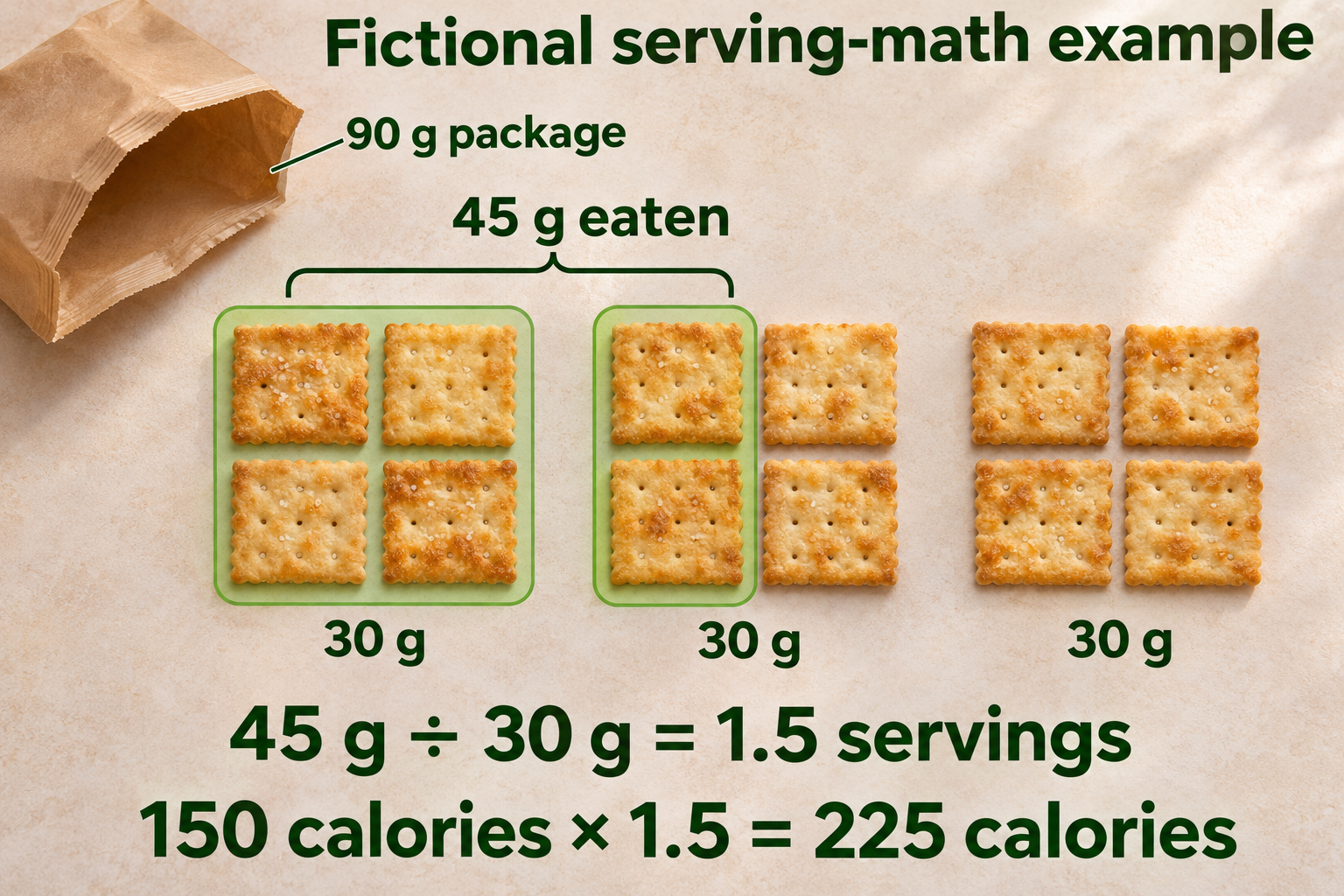
Suppose you ate 45 g of the fictional crackers.
- Divide 45 g by 30 g to get 1.5 servings.
- Multiply 150 calories by 1.5 to get 225 calories.
- Multiply 180 mg sodium by 1.5 to get 270 mg sodium.
Fictional example
| Amount eaten | Servings eaten | Calories | Sodium |
|---|---|---|---|
| 15 g | 0.5 | 75 | 90 mg |
| 30 g | 1 | 150 | 180 mg |
| 45 g | 1.5 | 225 | 270 mg |
| Whole 90 g package | 3 | 450 | 540 mg |
Fictional serving-math example. The highlighted amount represents one full 30 g serving plus half of another.
Match the calculation to the label basis
Half of this fictional 90 g package is 45 g. You can reach the same answer by taking half of the whole-package values, giving 225 calories and 270 mg sodium. That agrees with the 1.5-serving calculation above.
Keep grams with grams when dividing. If you use the label's household quantity, keep that unit consistent too. Before multiplying a value by the number of servings eaten, check that the value is listed per serving. In the fictional example, the 450-calorie container value already includes all 3 servings.
Before recording a portion, check these details.
- What quantity counts as one serving?
- Which quantity does the column describe?
- How much did you eat?
Try the calculation on your next package
Find the serving size on a package you have, measure your portion and work out the number of servings. Then calculate one value you want to record, such as calories or sodium.
For the broader package-label workflow, see Eatibo’s related guide. nutrition facts scanner guide
Sources
- FDA guidance on serving quantities and typical consumption. Serving Size on the Nutrition Facts Label
- FDA guidance on proportional calculations and dual-column panels. How to Understand and Use the Nutrition Facts Label