
Enriched vs Fortified Foods: What the Label Can Tell You
The common fortified vs enriched explanation is useful, but incomplete. "Enriched" often means nutrients lost during processing were added back. "Fortified" often means nutrients were added beyond what the food originally contained. On a US food label, however, the two words are not always mutually exclusive. The FDA says they may be used interchangeably in some labeling claims unless a regulation requires specific wording.
So the practical question is not just which word appears on the package. Check which nutrient was added, how much the labeled serving provides, and what else the food contains.
| Label term | Common teaching meaning | What to verify on the package |
|---|---|---|
| Enriched | Nutrients removed during processing were restored | The ingredient list, regulated food name, serving size, and listed nutrient amounts |
| Fortified | Nutrients not originally present, or present at lower levels, were added | The added nutrient, amount per serving, % Daily Value when shown, and the rest of the nutrition profile |
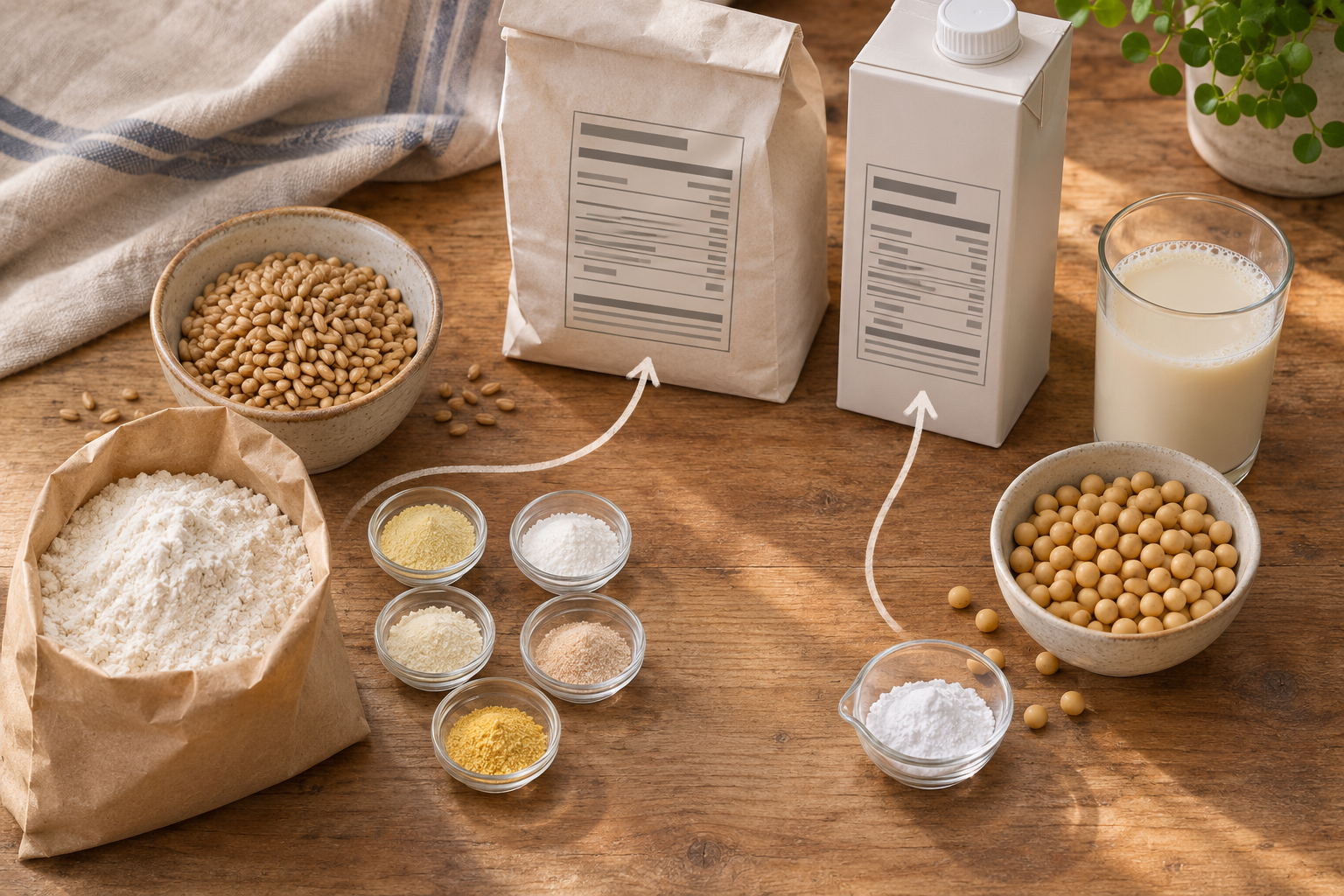
Editorial illustration: nutrient restoration and addition can start differently, but both still send you to the package label. The packages and nutrient dishes are illustrative, not real products or FDA label examples.
Why the usual distinction needs an FDA footnote
The restoration-versus-addition rule is a good memory aid. FDA policy itself includes restoration as one reason for adding nutrients to foods. Yet the agency's labeling guidance says "enriched," "fortified," and similar terms may be used interchangeably to indicate that essential nutrients were added, unless a federal rule requires a particular term. The FDA fortification guidance explains both the overlap and the exceptions.
Standards of identity create some of those exceptions. For example, the FDA says enriched flour must contain specified levels of thiamin, riboflavin, niacin, iron, and folic acid. A standardized product cannot simply replace the regulated name "enriched flour" with "fortified flour."
The same guidance gives calcium added to a soy beverage as an example of a rational nutrient addition. That fits the everyday idea of fortification: adding a nutrient to a food that can serve as a useful source. The examples show why the process distinction helps, while the printed word alone cannot settle every labeling question.
Read the ingredient list and Nutrition Facts together
Start with the ingredient list. Added vitamins and minerals may appear by their nutrient or ingredient names, such as iron, folic acid, thiamin, riboflavin, niacin, calcium, or vitamin D. The exact list depends on the product. If an unfamiliar ingredient gets in the way, the narrower guide to using a food ingredient checker explains how to review label terms without treating every long name as a warning.
Then move to Nutrition Facts:
- Confirm the serving size and servings per container.
- Find the nutrient that the package says was added.
- Read its amount and % Daily Value, if the label provides one.
- Check other values that matter to your comparison, such as added sugars, fiber, saturated fat, or sodium.
The FDA notes that all nutrient amounts on the panel refer to the labeled serving. If you eat two servings, you get twice the listed amount. %DV shows how much one serving contributes to the daily reference amount for that nutrient. For a closer explanation, see how to use %DV on food labels.
Two fictional cereals, two different decisions
The numbers below are invented for illustration. Both cereals use the same 40 g serving so the rows can be compared directly. They are not FDA examples, laboratory results, or Eatibo scan results.
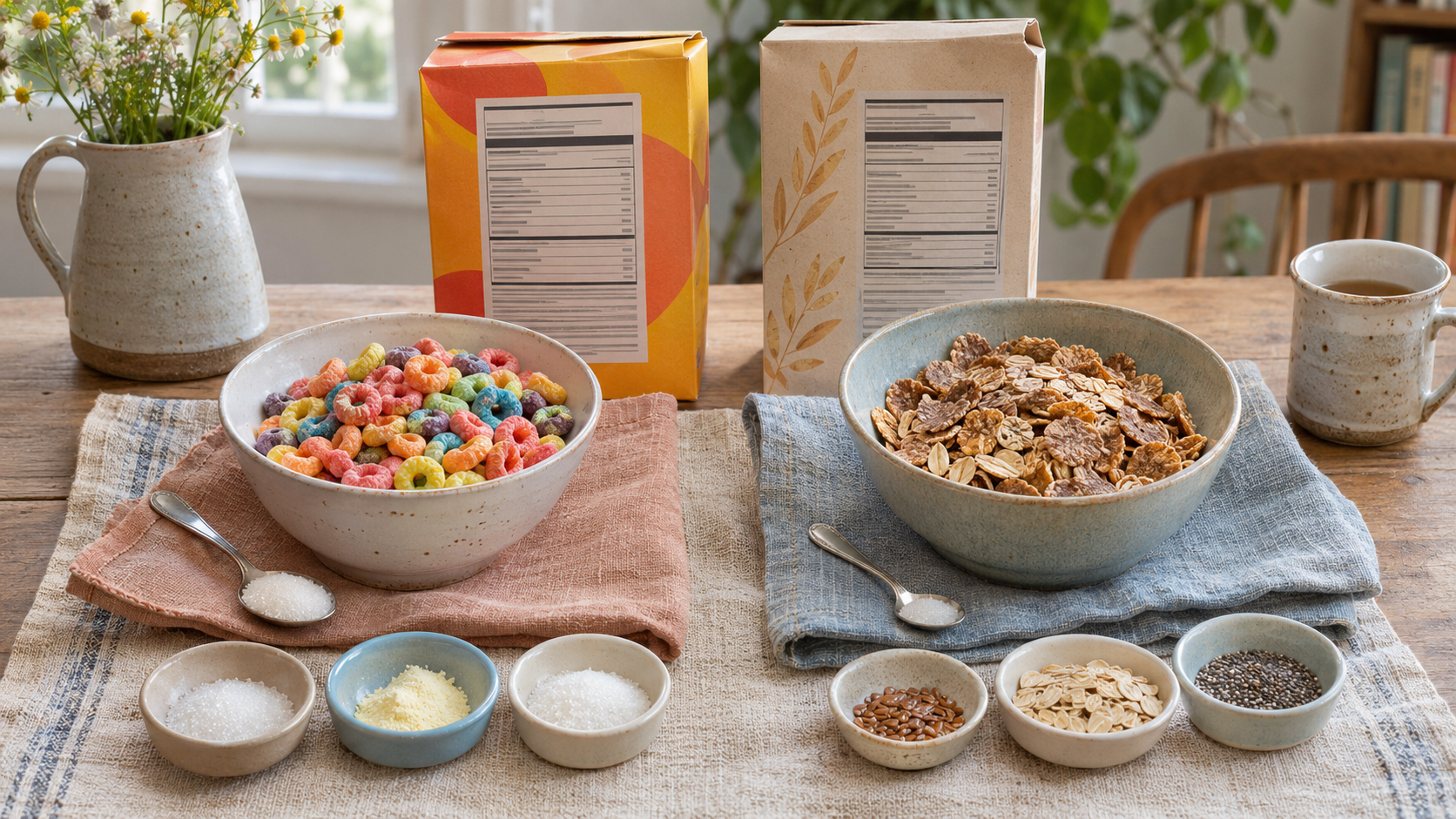
Editorial illustration: the added nutrient is only one part of a cereal comparison. The packages, foods, and label panels are fictional.
| Simplified label row, per 40 g serving | Cereal A | Cereal B |
|---|---|---|
| Added sugars | 12 g | 4 g |
| Dietary fiber | 2 g | 5 g |
| Sodium | 230 mg | 180 mg |
| Iron | 8 mg | 2 mg |
| Calcium | 40 mg | 260 mg |
| Vitamin D | 0 mcg | 4 mcg |
| Added nutrient ingredients | Iron and folic acid | Calcium and vitamin D |
Cereal A has more iron in this fictional comparison. Cereal B has more calcium, vitamin D, and fiber, with less added sugar and sodium. That still does not turn "more fortified" into a complete health score. Your choice may depend on the nutrients you are comparing, the rest of your diet, allergies or preferences, and the amount you will eat.
If you pour 80 g instead of the listed 40 g serving, double every value in the table. That simple step often changes the comparison more than the front-of-package wording does.
What enriched and fortified do not tell you
Enriched and fortified foods can supply added nutrients. Those terms do not establish all of the following:
- Whole-grain status. Check the product name and ingredient list for the actual grain ingredients.
- An overall balanced nutrition profile. Added vitamins or minerals do not erase the serving's added sugars, sodium, saturated fat, or other values.
- The right portion for you. The panel reports nutrients for its labeled serving, which may differ from what you eat.
- A need for a dietary supplement. The FDA fortification policy discussed here applies to conventional foods, not dietary supplements. A food label does not diagnose a deficiency or decide whether supplementation is appropriate.
This is also why a single word on the front of a package should not overrule the back label. Use the claim as a prompt to verify, not as the conclusion.
A 60-second label check
Use this sequence on one product you already have:
- Circle the claim: enriched, fortified, added, plus, extra, or a named vitamin or mineral.
- Find the matching nutrient in the ingredient list.
- Locate that nutrient on Nutrition Facts and confirm the serving size.
- Compare the amount and %DV with another product only when the serving sizes are the same.
- Scan the rest of the panel for the values that matter to your decision.
- Record what you actually ate, not just the package serving.
Eatibo supports meal-photo, barcode, and ingredient-label inputs for building a nutrition record. You can review Eatibo's food-scanning and nutrition-recording workflow, then verify the printed package and portion before relying on any saved record.
Frequently asked questions
Is enrichment the same as fortification?
Not in the common teaching definition: enrichment usually describes restoring nutrients lost during processing, while fortification describes adding nutrients that were not there before or increasing them. US labeling practice has overlap. FDA guidance allows the terms to be used interchangeably in some claims, but standardized foods may require exact wording.
Are fortified foods automatically healthier?
No. Fortification tells you that one or more nutrients were added. It does not summarize added sugars, sodium, saturated fat, fiber, serving size, or the rest of your eating pattern. Review the whole label for the decision you are making.
Does enriched flour mean whole-grain flour?
No. "Enriched" describes added nutrients, while "whole grain" concerns the grain ingredients. Read the product name and ingredient list rather than treating the terms as substitutes.
Should I choose fortified food instead of a supplement?
The label cannot answer that personal health question. Conventional foods and dietary supplements follow different labeling frameworks, and FDA's food fortification policy does not apply to dietary supplements. Do not infer a deficiency or a need for supplements from an enriched or fortified claim.
Sources
- FDA: Questions and Answers on FDA's Fortification Policy, November 2015 guidance, especially pages 5 and 15-16.
- FDA: How to Understand and Use the Nutrition Facts Label, serving information and % Daily Value sections.
- Eatibo official website, product workflow checked during drafting.