
Percent Daily Value: How to Use %DV on Food Labels
Percent daily value, written as %DV, tells you how much one serving contributes to a nutrient's Daily Value. The Daily Value is the nutrient-specific reference amount. The %DV is the share supplied by the labeled serving. It is not the percentage of the food's weight, and it is not the percentage of its calories.
That distinction answers both "what is percent daily value?" and "what does daily value mean?" The FDA explains that Daily Values are reference amounts, while %DV connects the amount in one serving to the relevant reference amount. The footnote on a Nutrition Facts label uses 2,000 calories a day for general nutrition advice. It does not calculate a personal calorie or nutrient target.
Before comparing two labels, make sure the serving sizes match. If you need to work out how many servings you ate, use our per serving versus per container guide.
Use 5% and 20% as a quick label-reading guide
The FDA uses two cutoffs: 5% DV or less per serving is low, and 20% DV or more is high. Values between those points do not need another label. They fall between the low and high guides.
For nutrients such as saturated fat, sodium, and added sugars, a lower %DV can help when comparing similar foods. For dietary fiber, vitamin D, calcium, iron, and potassium, a higher %DV can help you find foods that contribute more of those nutrients. This is a comparison aid for one nutrient at a time, not a score for the food as a whole and not a rule for personalized treatment.
Compare two fictional labels, one nutrient at a time
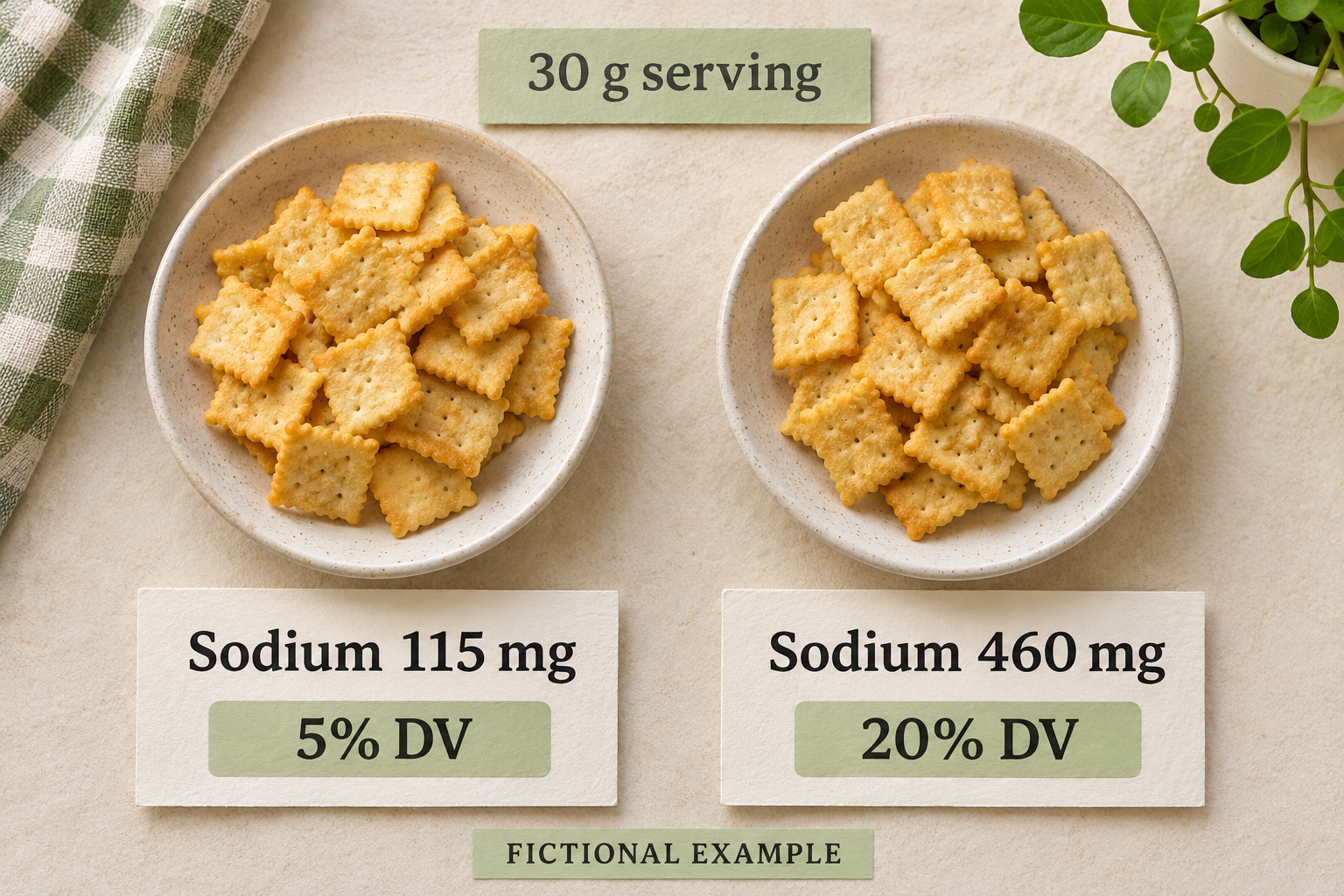
The example below uses two fictional foods with the same declared serving size: 30 g. It is a teaching example, not a reproduction of a regulated retail label or a laboratory result.
For sodium, the Daily Value is 2,300 mg. The basic arithmetic is:
nutrient amount ÷ that nutrient's DV × 100
The units must match before you calculate.
| Fictional example | Serving | Nutrient amount | Daily Value used | Arithmetic | Result |
|---|---|---|---|---|---|
| Food A | 30 g | Sodium 115 mg | 2,300 mg | 115 ÷ 2,300 × 100 | 5% DV |
| Food B | 30 g | Sodium 460 mg | 2,300 mg | 460 ÷ 2,300 × 100 | 20% DV |
| Separate fiber example | 30 g | Dietary fiber 5.6 g | 28 g | 5.6 ÷ 28 × 100 | 20% DV |
Food A is low in sodium by the FDA's guide. Food B is high in sodium. The separate fiber row also equals 20%, but that percentage refers to the fiber Daily Value, not the sodium Daily Value. A 20% result always needs its nutrient name and serving basis.
On a real package, use the manufacturer's printed %DV when it is present. Federal calculation and rounding rules can make a hand calculation differ from the displayed percentage even when you copied the nutrient amount correctly.
What a missing %DV does and does not tell you
A blank %DV does not mean zero. The FDA notes that total sugars and trans fat do not have an established Daily Value, so their rows do not show %DV. Protein has a Daily Value, but its %DV is not required on every label. For example, the requirement depends on factors that include whether the label makes a protein claim and who the product is intended for.
Read the amount and unit that are present. Keep missing information unknown instead of converting a blank into zero.
Check a scanned record against the package
A scan can reduce typing, but the package remains the reference in your hand. Check the record in this order:
- Confirm the exact product and the labeled serving.
- Match the nutrient name, amount, and unit.
- Copy or compare the printed %DV when the package provides one.
- Leave a missing value unknown.
Eatibo can use a label photo or product barcode to identify a packaged food and help create a useful record. Barcode databases can be incomplete, outdated, or tied to another market, so confirm the result against the current package. The public Eatibo food scanner does not promise an automatic %DV calculation. For the broader scan, check, and log workflow, read the nutrition label scanner guide.
Does 20% DV mean 20% of the food is that nutrient?
No. It means one labeled serving supplies 20% of that nutrient's Daily Value. In the fictional sodium example, 460 mg is 20% of the 2,300 mg sodium Daily Value. It does not mean sodium makes up 20% of the food's weight or calories.
Do I need exactly 100% of every nutrient?
No. %DV is a general label reference for comparing how foods contribute to a daily diet. It is not an individualized treatment target, and a single food does not need to supply every nutrient in a particular proportion. If a clinician has given you a specific target, do not treat the general label reference as a replacement for that guidance.
The practical takeaway is to check the nutrient and serving basis, read that nutrient's %DV, then compare the same nutrient across similar foods. Keep the name, amount, unit, and percentage together so the number retains its meaning.