
What Is Sugar Alcohol? Food Examples and Label Checks
Sugar alcohol is a type of carbohydrate used to sweeten or add texture to food. It is not the alcohol found in beer, wine, or spirits. The name comes from its chemical structure, not from an intoxicating effect.
You will often find sugar alcohols in sugar-free or reduced-sugar gum, candy, baked goods, and desserts. They can provide sweetness with fewer calories per gram than sugar, but that does not make a product carbohydrate-free or calorie-free. The FDA's sugar alcohol fact sheet recommends checking both the ingredient list and the Nutrition Facts panel.
Common sugar alcohols in food
The FDA lists erythritol, hydrogenated starch hydrolysates, isomalt, lactitol, maltitol, mannitol, sorbitol, and xylitol as examples. You do not need to memorize the whole list. Start by noticing these names when a package says "sugar-free," "reduced sugar," or "no sugar added."
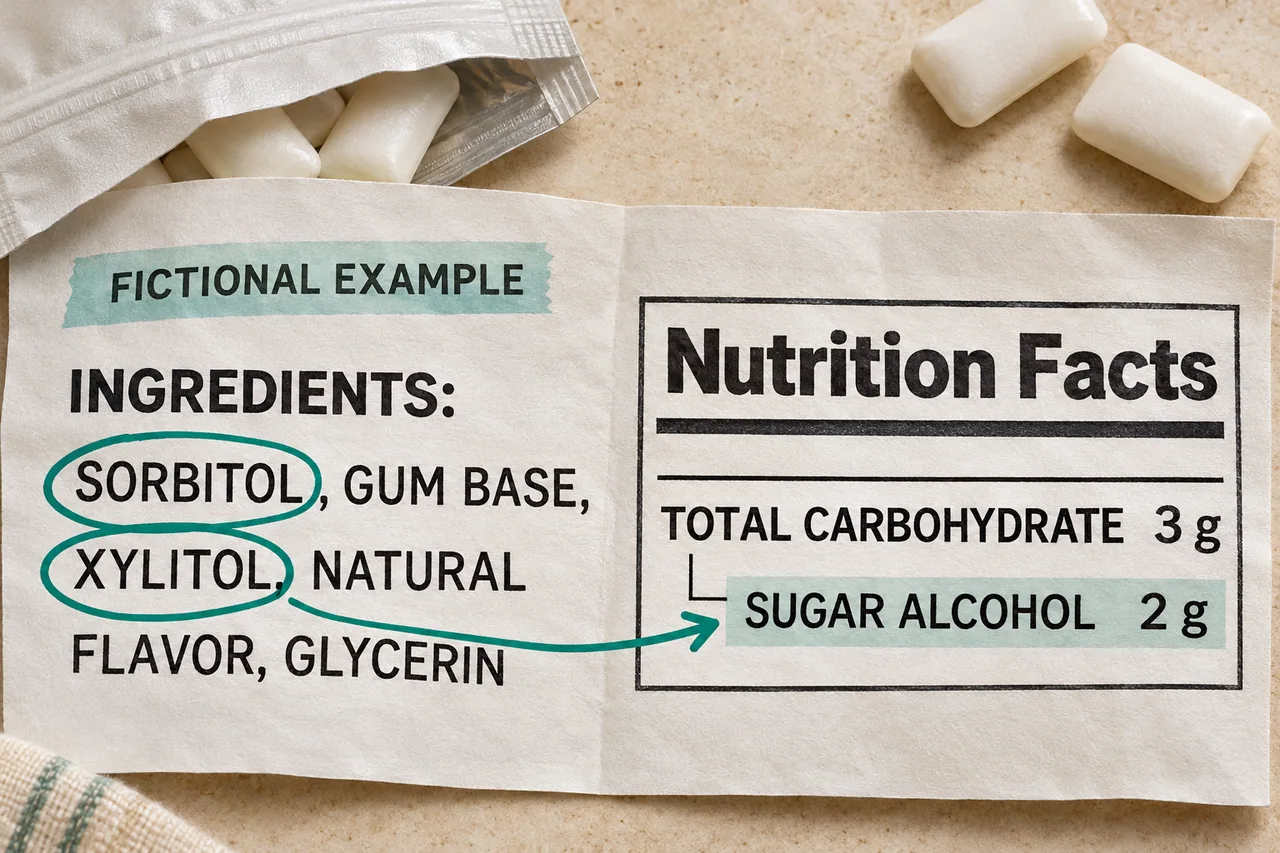
Illustrative label, not a real product. The ingredient names and label position follow the FDA sugar alcohol guidance; the gram values are fictional.
Consider this fictional chewing-gum ingredient list:
Sorbitol, gum base, xylitol, natural flavor, glycerin.
Sorbitol and xylitol are the sugar alcohols. Finding them in the ingredient list tells you which sweeteners the gum contains. It does not tell you the number of grams in a serving. For that, check whether the Nutrition Facts panel includes a Sugar Alcohol line.
A fictional snack bar might list:
Protein blend, erythritol, almond butter, cocoa, salt.
Here, erythritol is the sugar alcohol. Ingredient order can help you understand the formula because the FDA says ingredients are listed by weight, but the order still does not replace the nutrient amounts on the label. If you want a broader routine for reading unfamiliar ingredients, use Eatibo's Food Ingredient Checker guide.
Where sugar alcohol appears on Nutrition Facts
When a manufacturer declares sugar alcohol, it appears in grams per serving under Total Carbohydrate. The manufacturer may list "Sugar Alcohol" or name a specific sugar alcohol if only one is added. Under FDA rules, this declaration can be voluntary, although certain package claims make it required. That detail matters: a missing Sugar Alcohol row is not proof that the amount is zero. Check the ingredient list as well. The FDA's interactive label guide explains the declaration rules and label position.
The comparison below uses invented values only:
| Fictional bar | Total Carbohydrate | Dietary Fiber | Total Sugars | Sugar Alcohol row | Ingredient clue |
|---|---|---|---|---|---|
| Bar A | 18 g | 7 g | 2 g | 4 g | Erythritol listed |
| Bar B | 18 g | 7 g | 2 g | Not shown | Maltitol listed |
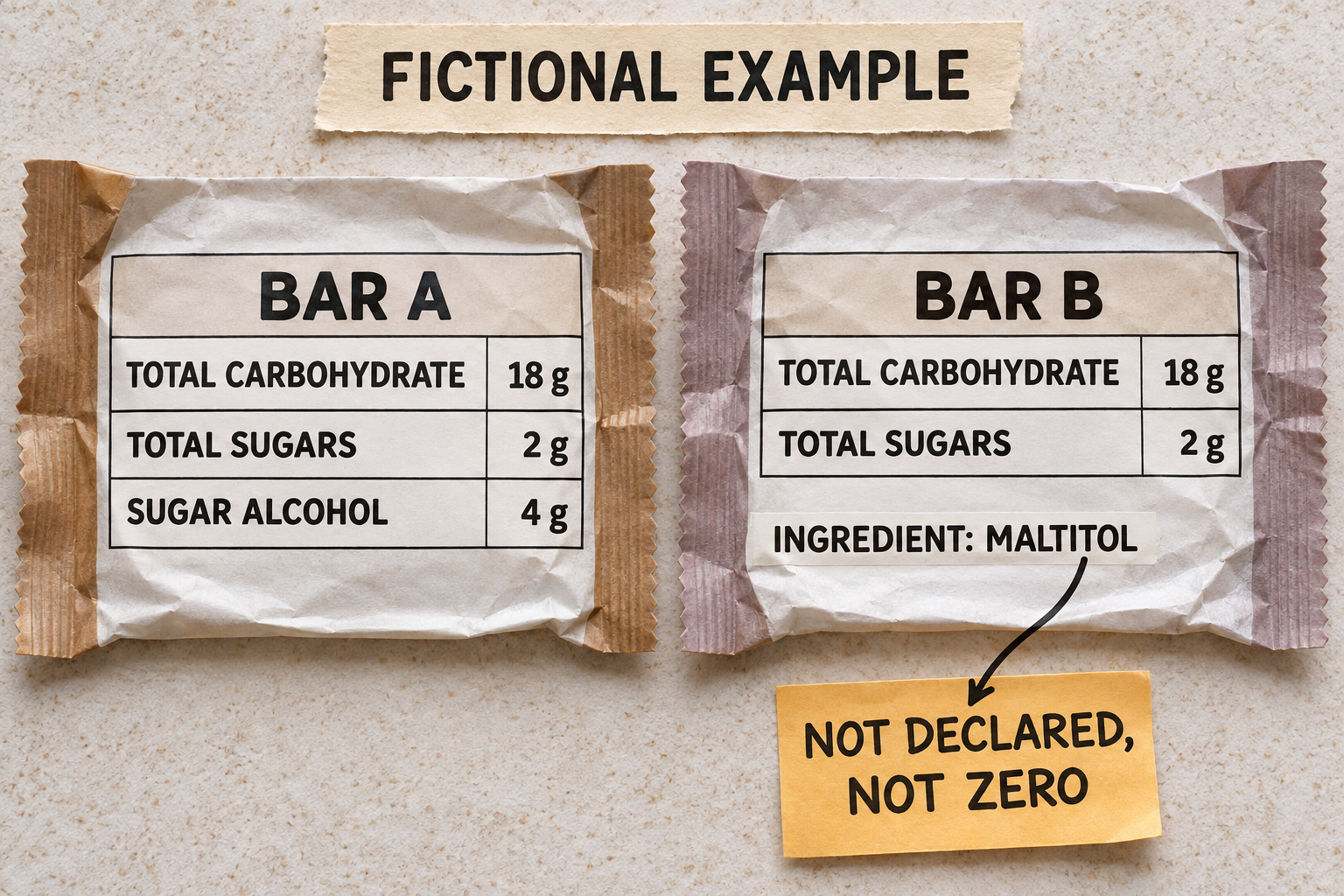
Illustrative labels, not real products. The values are fictional. The omitted-row lesson follows the FDA's declaration rules.
Bar A declares 4 g of sugar alcohol per serving. Bar B does not show a Sugar Alcohol row, but maltitol appears in its ingredients. The honest entry for Bar B is "not declared," not 0 g. Do not copy the fictional numbers into a food log.
Total Carbohydrate remains the starting point for understanding the whole serving. The American Diabetes Association notes that the total carbohydrate line covers the carbohydrate types on a packaged-food label. If you are comparing snacks, read that row with the serving size and the ingredient list rather than treating one front-of-package claim as the answer. Eatibo's low-carb snack label guide covers the broader comparison without turning this article into a net-carb calculation.
Sugar-free does not mean carbohydrate-free
Sugar alcohols usually provide fewer calories per gram than sugar, but the amount varies by type. A single calorie value would be misleading for the whole group. Other ingredients in the food can also contribute carbohydrate, fat, protein, and calories.
This is why a sugar-free package can still show Total Carbohydrate and calories. The FDA advises comparing the calories and nutrients in a sugar-free version with the regular version. For a snack-specific check of added sugar and other sweeteners, see the low-sugar snacks guide.
The labels answer different questions. The FDA's added-sugars guide explains that Total Sugars includes naturally occurring sugars and any added sugars in the product, while the Added Sugars line reports the amount added during processing or packaged as a sweetener.
| Label term | What it tells you |
|---|---|
| Total Sugars | Sugars present in the serving, including naturally occurring and added sugars |
| Added Sugars | Sugars added during processing, shown as part of Total Sugars |
| Sugar Alcohol | A declared amount of polyol sweeteners, when the line is present |
| Total Carbohydrate | The broader carbohydrate amount for the serving |
Digestive tolerance varies
Sugar alcohols are not absorbed in the same way as regular sugar. The FDA says some people can experience gas, bloating, or diarrhea because sugar alcohols may be incompletely absorbed and then fermented in the large intestine. The FDA also requires a laxative-effect warning on foods that contain sorbitol or mannitol in circumstances covered by its rule.
That does not establish one safe amount for everyone. Product type, serving size, the specific sugar alcohol, and individual tolerance all matter. If a food seems connected to recurring symptoms, keep the package and discuss the pattern with a qualified health professional instead of using an article to diagnose an intolerance.
A five-step label check before you log the food
- Confirm the serving size. Match the printed serving with the amount you ate or plan to eat.
- Read Total Carbohydrate. Keep the full carbohydrate row in view, even when the package says "sugar-free."
- Look for a Sugar Alcohol line. Record the printed grams when the label declares them. If the line is absent, do not enter zero based on the omission alone.
- Scan the ingredient list. Look for names such as erythritol, maltitol, mannitol, sorbitol, or xylitol.
- Save the source details. Keep the exact product, serving, and package information with your food record so you can check it later.
Eatibo supports food scanning and nutrition recording. Use it to review the package and keep a record, then verify the printed serving and label before relying on the entry.
Frequently asked questions
Is sugar alcohol the same as drinking alcohol?
No. Sugar alcohols do not contain the type of alcohol found in alcoholic beverages. The shared word "alcohol" describes part of their chemical structure.
Are sugar alcohols the same as sugar?
No. Both are carbohydrates used in foods, but they are different groups. On a Nutrition Facts panel, Total Sugars and Added Sugars are separate from a declared Sugar Alcohol line.
What is sugar alcohol in food?
It is a carbohydrate ingredient used for sweetness, bulk, texture, or moisture. Common examples include erythritol, maltitol, mannitol, sorbitol, and xylitol.
Does an omitted Sugar Alcohol row mean 0 grams?
No. The FDA allows voluntary declaration in some cases and requires it in others. If the row is missing, check the ingredient list and treat the amount as unknown unless the package or manufacturer supplies it.
Does sugar-free mean no carbohydrates or calories?
No. A sugar-free food can still contain sugar alcohols and other ingredients that contribute carbohydrate or calories. Check the serving size, Total Carbohydrate, calories, and ingredients.