
Total Sugar vs Added Sugar: Read the Two Label Lines Correctly
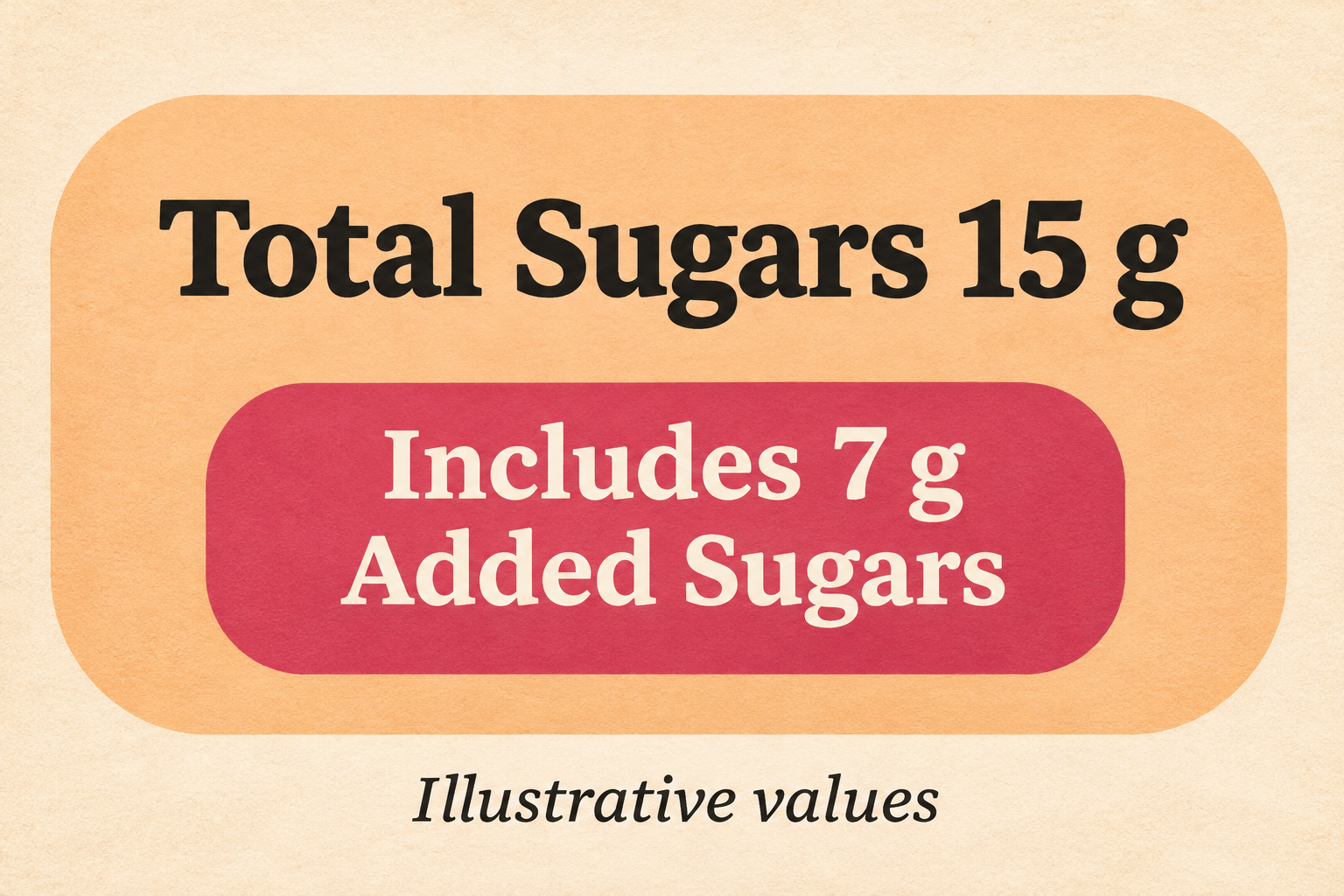
Total sugars already include added sugars. On a US Nutrition Facts label, the indented line "Includes X g Added Sugars" tells you how much of the total came from sugars added during processing or preparation. It is not a second amount to add.
If a label says 15 g Total Sugars and "Includes 7 g Added Sugars," the food has 15 g of sugar per labeled serving, not 22 g. The added 7 g sits inside the total 15 g. The remaining 8 g comes from sugars that were already present in ingredients such as milk or fruit. This is the relationship the FDA explains for the word "Includes".
Illustrative values. The added-sugars amount is part of the total, not a second amount.
A 15 g total, 7 g added example
Consider this hypothetical yogurt label:
| Label line | Amount per 170 g serving | How to read it |
|---|---|---|
| Total Sugars | 15 g | All sugar in the serving |
| Includes Added Sugars | 7 g | The part of the 15 g that was added |
The arithmetic is:
15 g total sugars = 8 g naturally occurring sugars + 7 g added sugars
Do not calculate 15 + 7. The word "Includes" is doing real work. FDA's label guidance uses the same 15 g total and 7 g added structure to show that the added amount is nested inside the total.
That is the mistake to avoid when comparing total sugar vs added sugar: the two lines are related, but they are not two totals.
Naturally occurring sugar and added sugar can share one food
Total sugars can combine more than one source:
- Plain milk contains naturally occurring lactose.
- Whole fruit contains naturally occurring sugars.
- Sweetened yogurt can contain milk sugar plus sugar added during processing.
- A fruit product can contain naturally occurring fruit sugar and an added sweetener.
The FDA's added-sugars guide says total sugars include sugars naturally present in milk and fruit as well as added sugars. It also lists honey and syrups among added sugars when they are used as sweeteners.
Neither line decides whether a food is a good fit for you. Sugar is one part of the label. Serving size, calories, protein, fiber, sodium, ingredients, and allergens may change the decision. If you are choosing a snack, the narrower guide to scanning added sugar before you buy adds that broader context.
Missing is not the same as 0 g
A scan, database entry, or manual record may leave a value blank even when the package has the information. Treat that blank as unknown, not as zero.
| What you can verify | What to record | What not to do |
|---|---|---|
| The printed label says 0 g Added Sugars | Record 0 g for the printed serving | Do not replace it with a guess |
| The added-sugars line is missing, cropped, or unreadable | Mark the value unknown and check the package again | Do not turn the blank into 0 g |
| An ingredient list names sugar, honey, or syrup but the grams are unreadable | Note the ingredient and keep the grams unknown | Do not estimate grams from ingredient order |
An ingredient list can tell you that a sweetener is present. It cannot supply the missing gram amount. Check a complete label for the same product and package instead of trying to reverse-engineer the number.
Compare equal portions before comparing sugar
Use the same portion basis for both foods. The FDA says label amounts and % Daily Values apply to the labeled serving, and it recommends matching serving sizes when comparing products.
Here are two fictional yogurts normalized to the same 170 g portion:
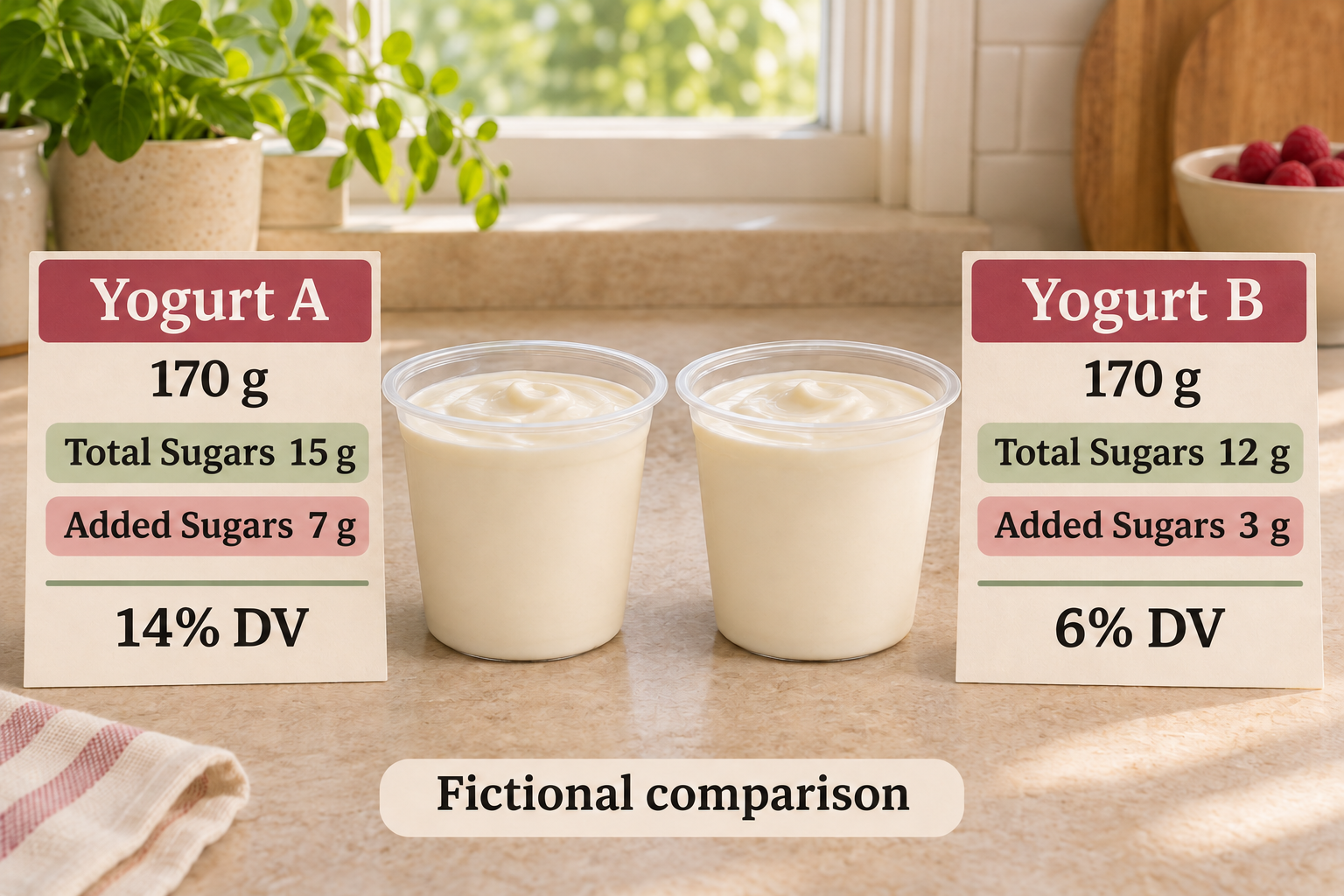
Fictional comparison for teaching. Check the printed values on the package you are using.
| Fictional yogurt | Portion | Total sugars | Added sugars | Added sugars %DV |
|---|---|---|---|---|
| Yogurt A | 170 g | 15 g | 7 g | 14% |
| Yogurt B | 170 g | 12 g | 3 g | 6% |
Yogurt B has less added sugar on this matched basis. The total-sugar gap is 3 g, while the added-sugar gap is 4 g, so the two lines answer different comparison questions. Do not use either difference to declare one yogurt better overall without checking the rest of the label.
The current Daily Value for added sugars is 50 g on a 2,000-calorie diet. Total sugars have no %DV because no Daily Reference Value has been established. The displayed %DV can help you compare the added-sugar contribution of equal servings without doing the math yourself. For the general method, see how to use %DV on food labels. If the packages use different serving bases, normalize them first with the per-serving versus per-container guide.
A short scan-and-check workflow
- Read the serving size and decide how much of the food you are comparing or recording.
- Read Total Sugars once. This is the full sugar amount for that serving.
- Read the indented "Includes Added Sugars" line as a subset of the total.
- Check the added-sugars %DV if you want a daily reference or a same-portion comparison.
- If the added-sugars value is missing from a scan or record, verify the printed package before saving a number.
- Review the rest of the label and ingredients before making a food decision.
You can use Eatibo to review its food-scanning and nutrition-recording workflow. Eatibo supports meal-photo, barcode, and ingredient-label inputs, but the printed package and the portion you ate remain the reference points to verify before relying on a record.
Frequently asked questions
Is honey an added sugar?
Honey is included in the FDA's definition of added sugars when it is added to a food as a sweetener. A jar of single-ingredient honey has special label treatment: its label can show an added-sugars %DV without declaring added-sugars grams in the same way as a multi-ingredient food. Check the label format before assuming a missing gram line means zero.
Does "no added sugar" mean sugar-free?
No. "No added sugar" is a claim about what was added during processing or packaging. A food can still contain naturally occurring sugar, so read Total Sugars. US rules treat "no added sugar" and "sugar free" as different claims; 21 CFR 101.60 sets separate conditions for them.
Does total sugar have a Daily Value?
No. The US Nutrition Facts label does not set a %DV for Total Sugars. It does set a Daily Value for Added Sugars. The FDA label guide explains that total sugars have no Daily Reference Value and that added sugars use a 50 g Daily Value on a 2,000-calorie diet.